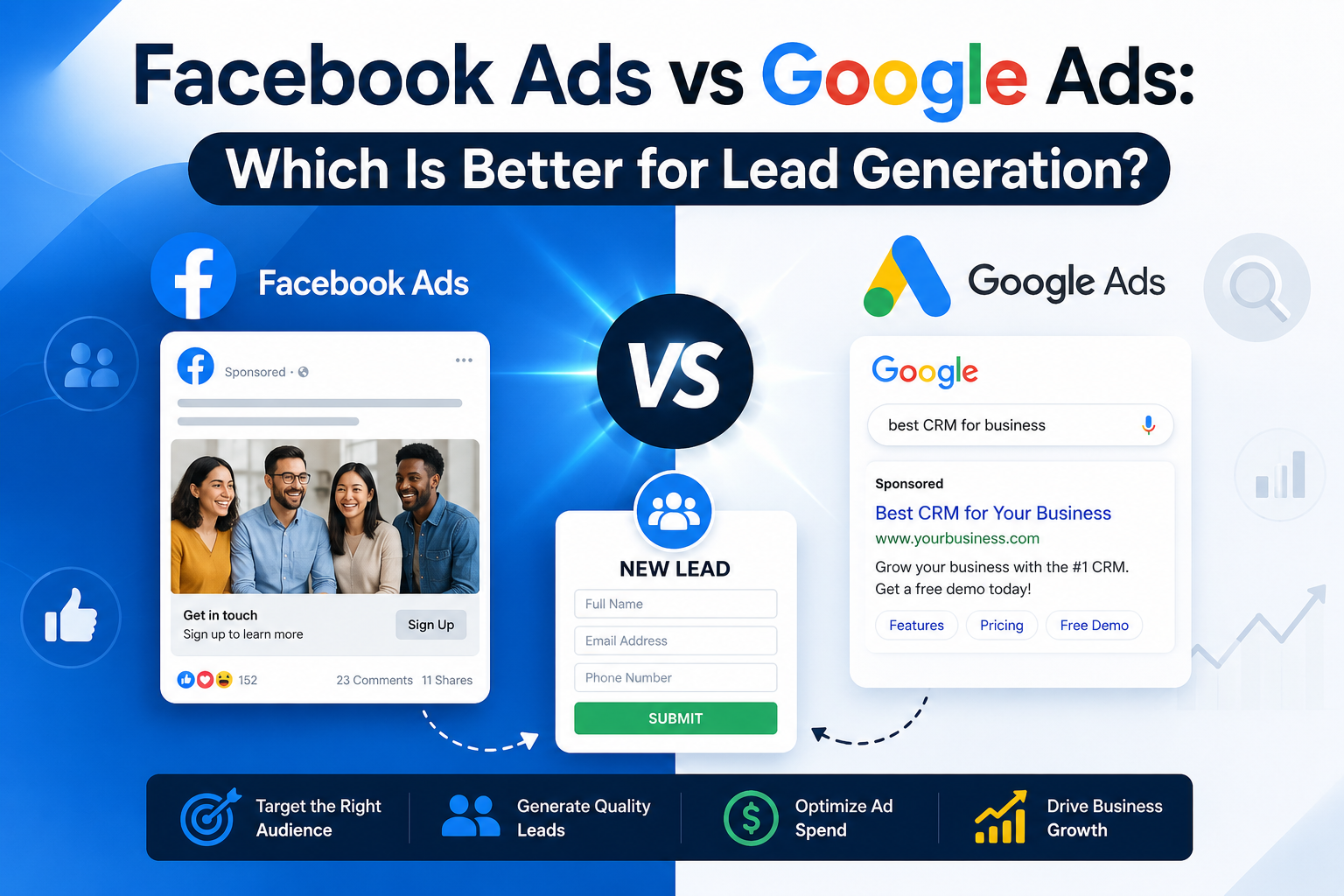
Facebook Ads vs Google Ads: Which Is Better for Lead Generation?
Meta Title: Facebook Ads vs Google Ads for Lead Generation: Which Platform Wins in 2025? Meta Description: Wondering whether Facebook Ads or Google Ads is better for lead generation? Discover a detailed comparison of costs, targeting, ad formats, and ROI to find the right platform for your business. Focus Keyword: Facebook Ads vs Google Ads for lead generation Long-Tail Keywords Used:
- how to generate leads using Facebook Ads for small businesses
- Google Ads vs Facebook Ads for B2B lead generation
- which platform is better for local business lead generation
- Facebook lead generation ads cost per lead comparison
- Google Ads search campaigns for high-intent lead generation
- best ad platform for real estate lead generation
- how to lower cost per lead with Facebook Ads targeting
- Google Ads vs Facebook Ads ROI for service-based businesses
If you've ever run a paid advertising campaign, you've probably faced this exact dilemma: Should I use Facebook Ads or Google Ads to generate leads?
Both platforms are powerhouses in the digital marketing world, but they work very differently — and choosing the wrong one can drain your budget without delivering results. Whether you're a small business owner, a digital marketer, or a startup founder trying to build a pipeline, this guide breaks down everything you need to know.
Let's dive deep into the Facebook Ads vs Google Ads debate and help you decide which platform is better for your lead generation goals.
Understanding the Core Difference: Intent vs Interest
Before comparing costs and features, you need to understand the fundamental philosophical difference between these two platforms.
Google Ads operates on search intent. When someone types "affordable plumber near me" or "best CRM software for startups," they are actively looking for a solution. Google puts your ad in front of people who already have a problem and are ready to solve it. This makes Google Ads incredibly powerful for capturing high-intent leads — people close to making a decision.
Facebook Ads, on the other hand, operates on interest and behavior. Facebook knows an enormous amount about its users — their demographics, interests, online behavior, life events, and purchasing habits. You can use this data to target audiences who may not be searching for your product right now, but fit the profile of your ideal customer. This is often called demand generation or top-of-funnel lead capture.
In short: Google finds leads who are looking for you. Facebook finds leads who don't know they need you yet.
How to Generate Leads Using Facebook Ads for Small Businesses
Facebook's Lead Ads format is a game-changer for small businesses. Instead of sending users to a landing page, Facebook allows prospects to submit their contact information directly within the app — with fields pre-populated from their Facebook profile.
Here's why this matters for small businesses:
- Lower friction: Users don't have to leave Facebook, which dramatically increases form completion rates.
- Mobile-first: Over 98% of Facebook users access it from mobile. Native lead forms are optimized for mobile in a way external landing pages often aren't.
- Granular targeting: You can target users by age, location, income level, job title, life events (like "recently moved" or "newly engaged"), and hundreds of interests.
- Lookalike audiences: Upload your existing customer list and Facebook will find new users who share similar traits — one of the most powerful features for scaling lead generation.
Best industries for Facebook lead generation: Real estate, insurance, gyms and fitness, home services, beauty and wellness, education, and local service businesses.
Google Ads Search Campaigns for High-Intent Lead Generation
Google Ads — specifically Search campaigns — are arguably the most direct form of lead generation in digital advertising. You bid on keywords that match what your potential customers are searching for, and your ad appears at the top of the results page.
Here's what makes Google Ads exceptional for leads:
- High purchase intent: People searching "buy accounting software for freelancers" are much further along in the buying journey than someone passively scrolling social media.
- Measurable ROI: Google makes it straightforward to track conversions, cost per lead, and return on ad spend.
- Keyword control: You can target very specific, niche long-tail keywords like "emergency HVAC repair in Austin Texas" — phrases that signal strong buying intent with less competition.
- Remarketing: Google lets you retarget users who visited your website but didn't convert, bringing them back into your funnel.
Best industries for Google Ads lead generation: Legal services, healthcare, financial services, SaaS, home repair and renovation, B2B software, and professional consulting.
Google Ads vs Facebook Ads for B2B Lead Generation
B2B lead generation is where the platforms diverge most significantly.
Google Ads for B2B tends to perform well because business buyers are often actively researching solutions. A procurement manager searching "enterprise inventory management software" is in a high-intent research phase. Google can put you directly in front of this person.
However, B2B keywords can be extremely expensive — sometimes $30 to $100+ per click for competitive industries like legal tech, finance, or HR software.
Facebook Ads for B2B has traditionally been seen as less effective, but this perception is changing. LinkedIn targeting is expensive, and Facebook's detailed behavioral targeting (including job titles, industries, and business-related interests) can rival LinkedIn at a fraction of the cost. Facebook's Lead Ads with gated content — like whitepapers, case studies, or webinars — are increasingly popular for B2B companies looking to build an email list of qualified prospects.
Verdict for B2B: Google Ads wins for bottom-of-funnel, high-intent captures. Facebook Ads works better for top-of-funnel awareness and lead nurturing campaigns.
Facebook Lead Generation Ads Cost Per Lead Comparison
One of the most asked questions is: which platform gives you a lower cost per lead (CPL)?
The honest answer is — it depends on your industry, targeting, ad creative, and offer. But here are general benchmarks:
PlatformAverage Cost Per Lead (CPL)
Facebook Ads
$5 – $50 per lead
Google Ads (Search)
$20 – $100+ per lead
Google Ads (Display)
$10 – $60 per lead
Facebook generally delivers a lower CPL because of its massive audience size and highly efficient targeting algorithms. However, the quality of leads from Google Ads tends to be higher because users are self-qualified — they searched for exactly what you offer.
A lower CPL means nothing if those leads never convert. Many businesses find that Google leads convert to customers at a higher rate, balancing out the higher upfront cost.
Pro tip: Track your cost per acquisition (CPA) — not just cost per lead — to get the full picture of which platform is actually delivering ROI.
Which Platform Is Better for Local Business Lead Generation?
For local businesses — think dentists, lawyers, electricians, gyms, or restaurants — both platforms offer strong tools, but with different strengths.
Google Ads Local Campaigns and Google Local Services Ads (LSA) are tailor-made for local businesses. When someone nearby searches "emergency electrician open now," your ad can appear at the very top of Google with your business name, reviews, and phone number. Calls and form submissions are tracked directly.
Facebook Ads for local businesses shine when you want to build awareness in your community before someone has a need. Running a promotion, event, or offer to people within 5 miles of your business can be incredibly cost-effective. Facebook's radius targeting and neighborhood-level audience tools make hyper-local campaigns easy to set up.
Verdict for local businesses: Use Google Ads to capture people with immediate needs. Use Facebook Ads to build brand awareness and stay top-of-mind.
Best Ad Platform for Real Estate Lead Generation
Real estate is a high-stakes category where both platforms are widely used — but each plays a different role.
Facebook Ads dominate real estate lead generation because they allow agents to target buyers and sellers based on life events (like "likely to move"), income ranges, homeownership status, and zip codes. Carousel ads showcasing property photos perform exceptionally well on Facebook and Instagram, driving high engagement and lead form submissions.
Google Ads are powerful for capturing buyers actively searching for properties — terms like "3 bedroom homes for sale in [city]" or "best realtor in [neighborhood]." These are high-intent queries and converting them can yield excellent clients.
Many top-performing real estate agents use both platforms together: Facebook to generate awareness and nurture prospects, and Google to capture searchers ready to take action.
How to Lower Cost Per Lead With Facebook Ads Targeting
If you're running Facebook Ads and finding your CPL too high, here are proven strategies to reduce it:
1. Refine your audience. Broad targeting wastes budget. Use layered targeting — combine demographics with behaviors and interests to build a precise audience.
2. Use Lookalike Audiences. Upload your best customers and let Facebook find similar users. 1% Lookalike Audiences often deliver the best CPL.
3. Test your creatives aggressively. Your ad creative (image, video, headline, copy) has a massive impact on CPL. Run A/B tests constantly and kill underperforming ads quickly.
4. Optimize your lead form. Fewer fields = more submissions. Ask only what you absolutely need — typically name, email, and phone number.
5. Use video ads. Video consistently outperforms static images for engagement and lead generation on Facebook. Even a 30-second smartphone video can cut your CPL significantly.
6. Retarget warm audiences. People who watched your video, visited your website, or engaged with your page are far more likely to convert — and retargeting them costs less than cold traffic.
Google Ads vs Facebook Ads ROI for Service-Based Businesses
Service-based businesses — consultants, agencies, coaches, healthcare providers, legal professionals — often struggle with which platform to prioritize.
Here's a practical framework:
- If your service solves an urgent problem (legal trouble, medical issue, broken equipment), use Google Ads. People in crisis search for help immediately.
- If your service requires education and trust-building (coaching, financial planning, premium consulting), use Facebook Ads to warm up leads through content and retargeting.
- If your service has strong visual appeal (interior design, photography, catering), Facebook and Instagram ads let you showcase your portfolio beautifully.
The highest ROI often comes from combining both: Google to capture demand, Facebook to create and nurture it.
The Verdict: Which Should You Choose?
There's no one-size-fits-all answer, but here's a simple decision framework:
Choose Google Ads if:
- Your customers actively search for what you offer
- You need leads with strong purchase intent
- You're in a service industry with urgent demand
- You have a decent budget and competitive keywords
Choose Facebook Ads if:
- Your audience doesn't know they need you yet
- You have visually appealing products or services
- You want to build a large audience cost-effectively
- You're targeting specific demographics or life stages
- You want lower cost per lead with volume
Best strategy: Use both. Many successful businesses run Facebook Ads at the top of the funnel to generate awareness and build retargeting lists, then use Google Ads at the bottom to close leads who are ready to act. Together, they create a full-funnel lead generation machine.
Final Thoughts
The Facebook Ads vs Google Ads debate doesn't have to be either/or. Each platform excels in different scenarios, and understanding those strengths is the key to building a lead generation strategy that works.
Start by clarifying your target customer, their buying journey, and your budget. Test one platform first, optimize your campaigns using the strategies outlined above, and then expand to the second platform once you have a proven baseline.
The businesses that consistently win at lead generation aren't loyal to one platform — they're loyal to their data. Let your results guide your budget.
Need help setting up your Facebook Ads or Google Ads lead generation campaigns? Start by defining your ideal customer profile and tracking your cost per acquisition — not just cost per lead.